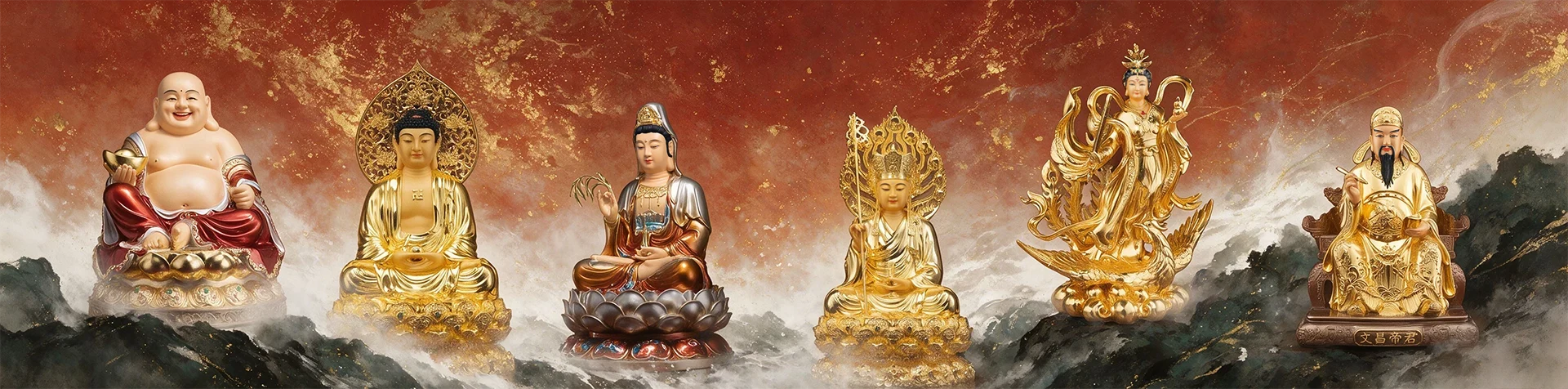
As an experienced copper manufacturer and supplier in China, Fuhui Veyly casts Xuantian Shangdi Statues from our Huizhou foundry, bringing the Northern Emperor's protection to homes, temples, and businesses from Taipei to Jakarta.
Our copper Xuantian Shangdi statues represent one of the most powerful and visually distinctive deities in the Taoist pantheon, known by many names across different traditions: Zhenwu Dadi, Xuanwu Dadi, the Supreme Emperor of the Dark Heaven, the Heavenly Lord Who Assists Heaven, the Demon-Subduing Celestial Venerable, and the Northern Emperor who commands the seven constellations of the north.
What makes Xuantian Shangdi the only Taoist deity who stands barefoot with flowing hair, sword in hand, and why do millions across Taiwan, Malaysia, and Singapore turn to him for protection against fire, flood, and evil spirits?
Unlike any other Taoist deity, Xuantian Shangdi embodies a unique convergence of cosmic forces: he is simultaneously the God of the North, the God of Water, the God of the Sea, the God of War, and the Demon-Subduing Celestial Venerable — five divine portfolios held by a single figure.
This extraordinary range of responsibilities makes him one of the most invoked deities for protection against fire, flood, evil spirits, and malevolent forces.
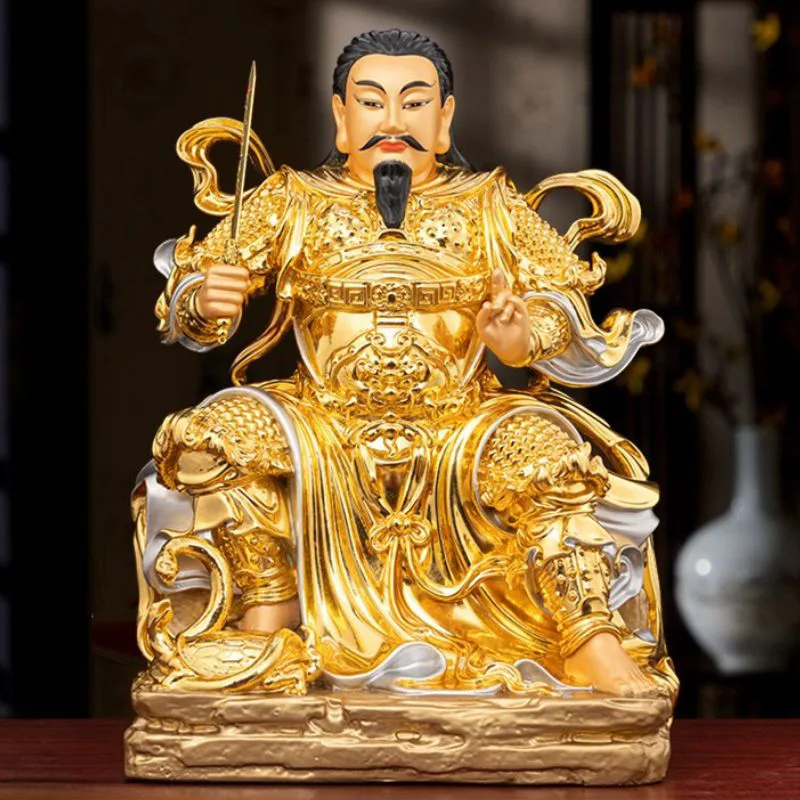
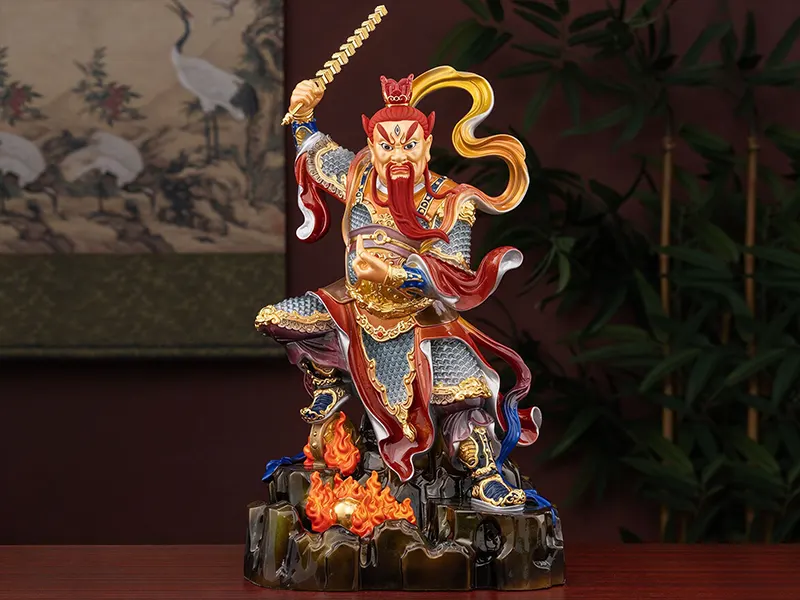
Every copper Xuantian Shangdi statue we produce follows his canonical iconography: flowing, unbound hair, a dark or black face, a black robe over golden armour, bare feet, the right hand gripping a seven-star sword, and the left foot planted on a tortoise while the right foot rests on a serpent, the two creatures that were once his internal organs, transformed into his loyal generals after his ascension.
Xuantian Shangdi's origins trace back over two millennia to ancient Chinese star worship.
The term "Xuanwu" originally referred to the seven northern constellations, which in ancient astronomy formed the shape of a tortoise entwined with a serpent.
By the Warring States period, Xuanwu was already documented as one of the four directional gods, the Black Tortoise of the North, alongside the Azure Dragon of the East, the Vermillion Bird of the South, and the White Tiger of the West.
But Xuantian Shangdi's transformation from a celestial constellation to a personified god is unparalleled. According to Taoist scripture, he was born as the prince of the Pure Music Kingdom, who renounced his throne to cultivate the Tao on Wudang Mountain before achieving enlightenment.
The Jade Emperor then appointed him to guard the northern heavens and subdue all demons under heaven. His cult reached its zenith during the Ming dynasty, when the Yongle Emperor credited his victory to Xuantian Shangdi's divine intervention and subsequently lavished resources on the Wudang Mountain temple complex.
To this day, Wudang Mountain remains the spiritual centre of Xuantian Shangdi worship, recognised as a UNESCO World Heritage Site and one of the most sacred Taoist mountains in China.
The devotion to Xuantian Shangdi has spread far beyond mainland China, carried by waves of Chinese migration across Southeast Asia.
Xuantian Shangdi is one of the most widely worshipped deities, with his faith introduced by Koxinga and his troops during the 17th century.
Today, numerous temples across the island are dedicated to him, including the renowned Beiji Temple in Tainan, which houses a Ming dynasty golden statue of Xuantian Shangdi designated as a national treasure.
Every year on the third day of the third lunar month, his birthday, tens of thousands of pilgrims converge on the Shou Tian Gong in Nantou's Songboling, one of the most important Xuantian Shangdi pilgrimage centres in Taiwan.
Xuantian Shangdi is a fixture in almost every Taoist temple. The Ma Xi Xuantian Shangdi Ancient Temple in Johor, Malaysia, has been actively preserving and promoting his faith through regional temple networks.
Xuantian Shangdi is enshrined alongside Guan Gong, Caishen, and Mazu at the San Chaopho Suea Shrine in Bangkok, where he is venerated by both Thai and Chinese communities.
His worship is equally widespread, with almost every Taoist temple providing an altar for Xuantian Shangdi.
Fuhui Veyly has produced copper Xuantian Shangdi statues for temples across these regions, making him one of the most requested Taoist deities in our production.
Our copper Xuantian Shangdi statues are produced in three distinct stylistic traditions, each serving different regional and devotional preferences.
This style depicts Xuantian Shangdi seated or standing with flowing unbound hair, a dark face, black robe over golden armour, barefoot with the left foot on a tortoise and the right on a serpent, the seven-star sword held upright in the right hand, and the left hand forming a mudra or resting on the belt.
This is the standard form for temple main halls and major shrine installations across Taiwan, Singapore, and Malaysia.
It features more vibrant polychrome finishes and sometimes incorporates regional variations, such as a more youthful facial expression or additional decorative elements on the armour.
It is preferred for community temples and household shrines across Thailand, Vietnam, and Indonesia.
It offers natural bronze or antique patina finishes with minimal surface treatment, appealing to art collectors, museums, and modern Taoist cultural centers.
Taiwanese and Wudang temple commissions: Gold-gilding
Southeast Asian folk shrines: Polychrome painting
Heritage restorations: Antique patina
Contemporary collections: Natural bronze.
The seated Xuantian Shangdi: Represents authority, stability, and cosmic governance.
The standing Xuantian Shangdi with sword raised: Symbolizes active protection and the power to subdue demons.
The Xuantian Shangdi on a throne with full regalia: Represents his celestial majesty as one of the highest deities in the Taoist pantheon.
The application scenarios for Xuantian Shangdi statues are uniquely tied to his role as the protector against fire, flood, and evil forces.
Our copper Xuantian Shangdi statues serve:
Taoist temple main halls: as the primary northern guardian.
Fire stations and maritime institutions: seeking protection from fire and water disasters.
Corporate headquarters and offices: protection against misfortune.
Residential homes and apartment buildings: for family safety.
Martial arts schools and training centers: he is revered as the patron of martial artists.
Community temples and shrines across Southeast Asia.
Xuantian Shangdi's ability to control the elements makes him particularly popular among communities vulnerable to fire and flood, a factor that has driven much of his worship across the tropical regions of Southeast Asia.
We offer complete customization: choose any regional tradition, any iconic pose, any size from 8 inches to 16 feet, any material, any finish, and even facial expression or sword position adjustments to match specific temple lineages.
Every custom project includes detailed 3D renderings for pre-casting approval, video consultations and production updates, and secure global shipping with heavy-duty wooden crating.
Standard production takes 45–60 days; gold-gilded, polychrome, or monumental projects over 10 feet require extended timelines.
Contact our Huizhou team for a free iconographic consultation to determine the most suitable tradition, pose, and finish for your temple or devotional space.