Fuhui Veyly is a reliable manufacturer and supplier of copper Skanda Bodhisattva statues, supporting customization services. Contact us today to get a quote.
How can you identify Skanda Bodhisattva among all guardian figures in a Buddhist temple?
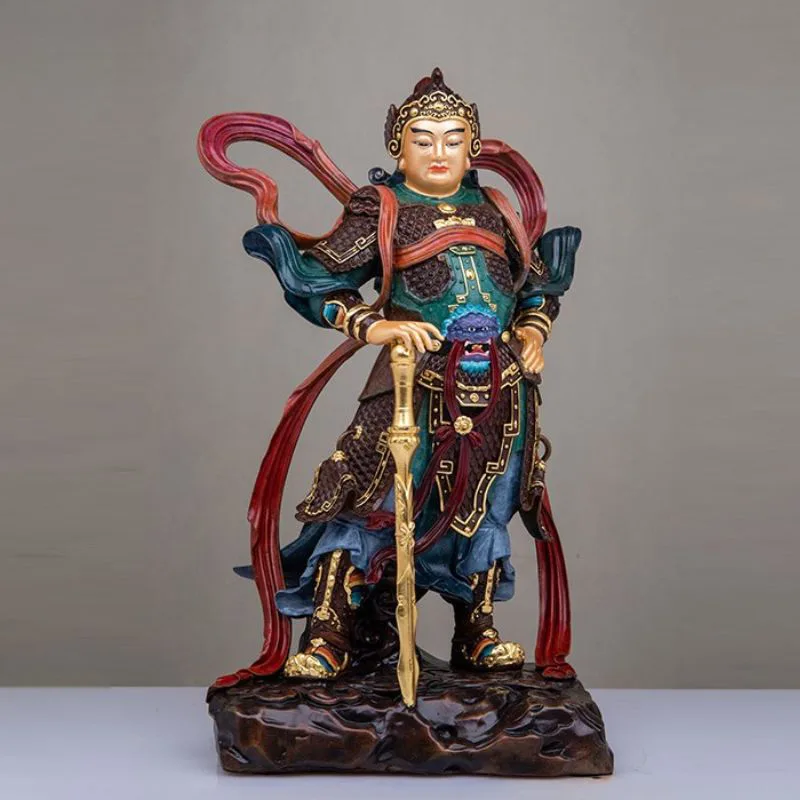
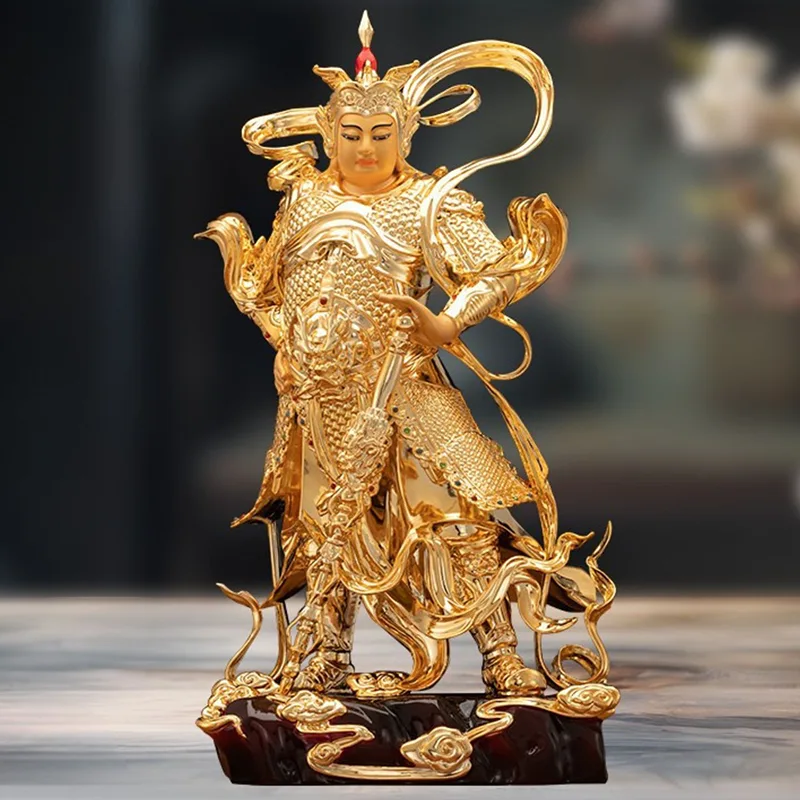
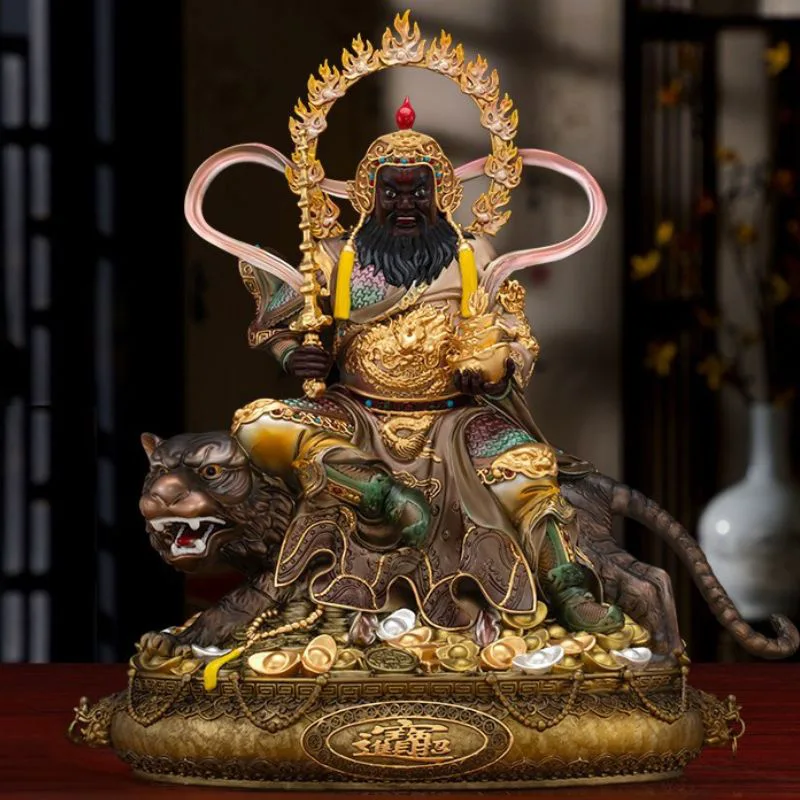
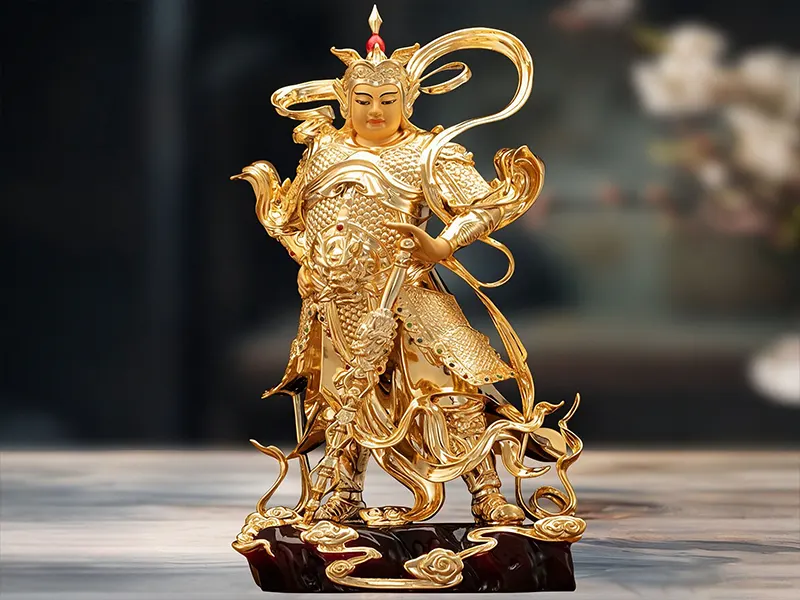
Our copper Skanda Bodhisattva statues represent the most widely venerated guardian in Mahayana Buddhism, the divine protector who stands in every temple's Heavenly King Hall, directly behind the laughing Maitreya, facing the main shrine with his vajra staff ready to defend the Dharma.
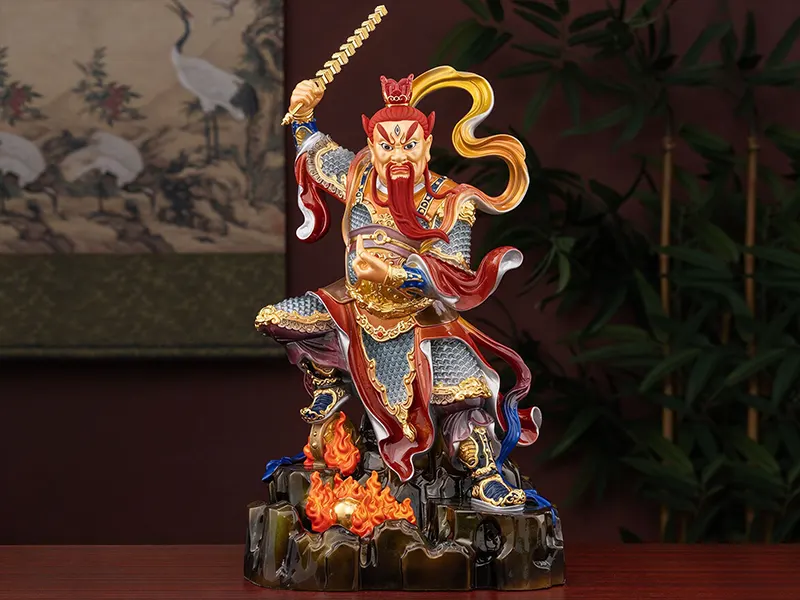
Unlike the serene Guanyin or the compassionate Ksitigarbha, Skanda appears as a fierce celestial general in full battle armour, his right hand gripping a vajra staff.
This martial appearance reflects his origin: Skanda was a general under Virudhaka, the Southern Heavenly King, and rose to become chief of the thirty-two divine generals who protect the Buddhist teachings.
Every statue we produce follows this canonical warrior iconography, with artisans dedicating weeks to perfect the armour scales, the flowing battle ribbons, the fierce yet compassionate facial expression, and the precise angle of the vajra staff — a detail that carries profound meaning across different temple traditions.
Using the lost-wax method with over 95% pure copper, our foundry hand-chases every detail before applying finishes such as 24k gold-gilding, antique patina, or polychrome painting, all protected by a 50-year anti-corrosion warranty.
Skanda's vajra staff position is not merely decorative, it is a silent communication system understood by Buddhist monastics across Asia.
1. When the staff is rested on the shoulder, it signals a large monastery capable of hosting travelling monks for three days.
2. When the staff is held horizontally across the arms, it indicates a medium-sized temple that can host monks for one day.
3. When the staff touches the ground, it signifies a small temple that cannot offer accommodation.
This tradition, which originated in Chinese Buddhism during the Song dynasty, has spread throughout Southeast Asia and Taiwan, where Skanda statues continue to convey this practical information.
Our copper Skanda Bodhisattva statues are commissioned with specific staff positions based on each temple's needs, and we maintain dedicated pattern archives for all three variations.
We have produced Skanda statues for Taiwanese temples, Malaysian Buddhist associations, Thai Chinese temples, Vietnamese pagodas, and Myanmar Chinese Buddhist temples, with a strong repeat order rate reflecting consistent satisfaction.
The devotion to Skanda manifests uniquely across the regions we serve.
Nearly every Buddhist temple pairs Skanda with Sangharama (Guan Gong) as the two principal Dharma protectors flanking the main shrine.
The only temple in Taiwan exclusively dedicated to Skanda is the Weituo Temple in Toucheng, Yilan, founded in 1902.
Skanda has been uniquely integrated into local traditions, where two statues are sometimes enshrined side by side, a purple Skanda representing glory and career advancement, and a red Skanda representing wealth and prosperity.
In Bangkok's Wat Nang Chee Chotikaram, a historic temple renovated by Chinese merchants during the reign of King Rama I, Skanda is venerated as a god of wealth.
Skanda is a standard feature in every Chinese Buddhist temple's Heavenly King Hall.
Skanda statues are commonly found in Mahayana pagodas.
Skanda is enshrined as the protector of the Three Jewels.
Our copper Skanda Bodhisattva statues are produced in three distinct stylistic traditions.
It depicts Skanda in full Tang or Ming dynasty-style armor with an elaborate helmet, flowing cape, and a stern yet compassionate expression — the standard form for temples across Taiwan, Malaysia, and Singapore.
It features more vibrant polychrome finishes and sometimes incorporates local design elements, such as the purple and red color symbolism found in Thai temples.
This offers natural bronze finishes with minimal surface treatment, appealing to Western Buddhist centers and art collectors.
Gold-gilding dominates Taiwanese and Malaysian temple commissions.
Polychrome painting is favored for Thai and Vietnamese community temples.
Antique patina for heritage restorations and natural bronze for contemporary collections.
Each tradition requires dedicated pattern archives and specific finishing techniques, all mastered by our Huizhou artisans with extensive experience in martial figure casting.
Standard production takes 45–60 days; monumental projects require extended timelines.
Please send us the following information for customization:
Regional tradition
Vajra staff position
Size from 8 inches to 14 feet
Material
Finish
Armor detailing adjustments to match specific temple lineages.
Our Huizhou foundry maintains a monthly processing capacity exceeding 10 tons, enabling us to handle both small custom pieces and large-scale temple projects.
Every custom project includes 3D renderings, video updates, and secure global shipping with heavy-duty crating.
Contact our team for a free iconographic consultation. Visit our pages for Skanda Bodhisattva Copper Statues, Weituo Zuntian Copper Statues, and Temple Protector Copper Statues.